
Introduction
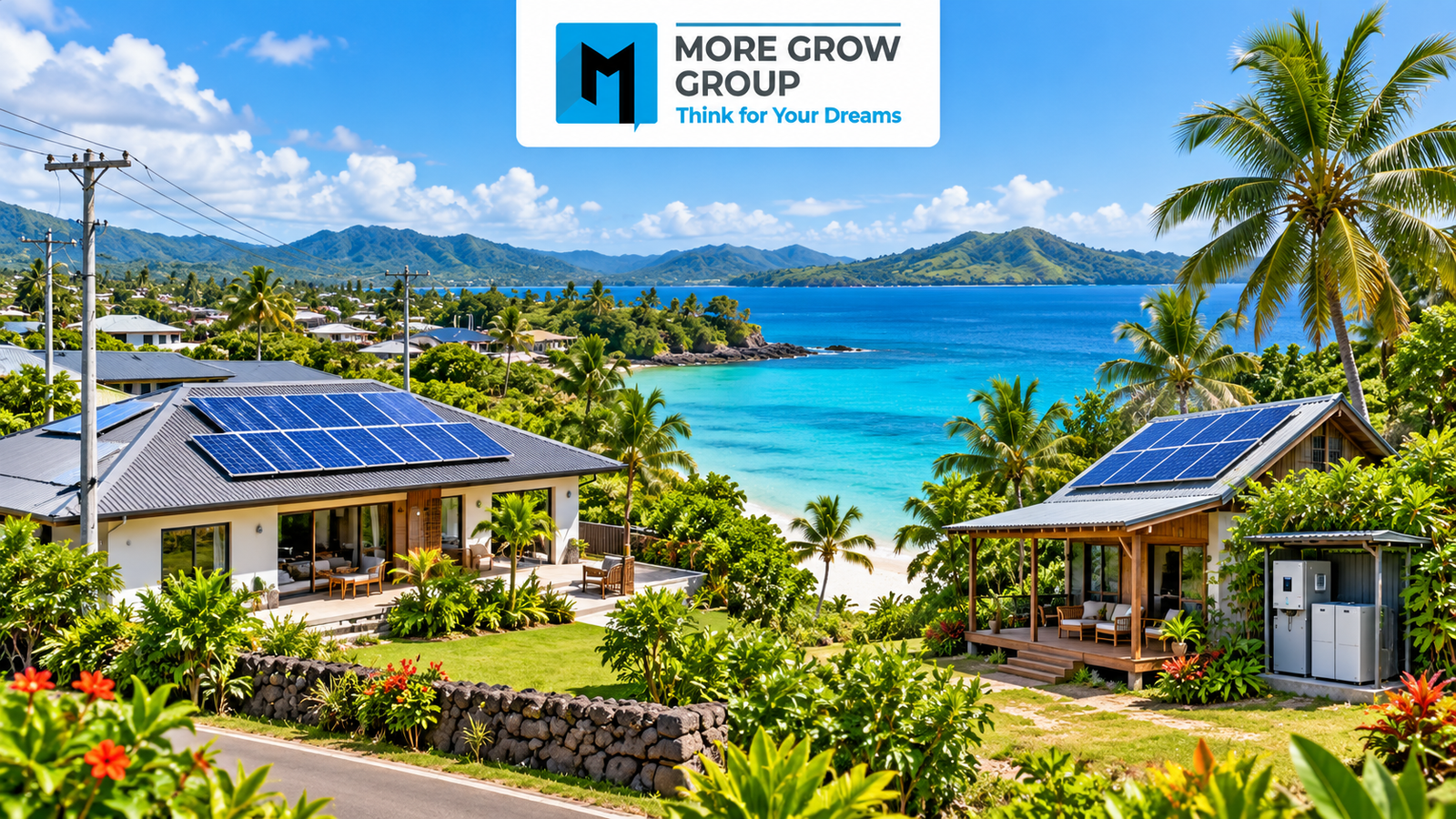
Solar power can help homes, businesses and communities in Fiji generate electricity and reduce reliance on purchased electricity or generator fuel. However, choosing a suitable system requires more than comparing solar panel prices.
Grid-tied and off-grid systems meet different needs. A property with an existing electricity connection may benefit from grid-tied solar, while a remote site without practical grid access may require an off-grid system.
The better option depends on your location, electricity consumption, backup requirements and budget. Understanding these differences helps you select a system that suits the property’s actual needs.
1. What Is a Grid-Tied Solar System?
A grid-tied solar system operates alongside the electricity network.
Solar panels generate direct-current electricity, which an inverter converts into electricity suitable for the property. Solar generation can supply connected appliances, while the grid provides additional electricity when solar output is insufficient.
A typical system includes:
- Solar panels.
- A grid-connected inverter.
- Mounting equipment.
- Electrical protection and wiring.
- Appropriate metering and connection arrangements.
A basic grid-tied system does not require batteries. At night, the property generally uses electricity from the grid.
Whether surplus generation can be exported, and whether any payment applies, depends on the approved connection arrangement. Buyers in Fiji should confirm these conditions with Energy Fiji Limited, or the relevant electricity provider, before purchasing.
2. What Is an Off-Grid Solar System?
An off-grid solar system operates independently of the main electricity network.
For a home or business requiring electricity beyond daylight hours, it typically combines solar panels with batteries and suitable power-conversion equipment. Some installations also include a backup generator.
Common components include:
- Solar panels.
- Battery storage.
- An off-grid inverter.
- Charge-control equipment.
- Electrical protection and monitoring.
- A backup generator where required.
During daylight hours, solar generation supplies loads and charges batteries. Stored energy supplies electricity when solar output is insufficient.
An off-grid system must be designed around the site’s electricity needs because the grid is unavailable to cover shortfalls.
3. What Are the Main Differences?
The main distinction is how each system handles periods when solar generation does not meet demand.
| Factor | Basic Grid-Tied System | Off-Grid System |
| Electricity network | Requires a grid connection | Operates independently |
| Battery storage | Optional | Usually needed for evening and overnight supply |
| Low solar output | Grid supplies the shortfall | Batteries or backup generation supply the shortfall |
| Grid outages | Usually shuts down | Can operate if its equipment and energy supply remain available |
| Initial cost | Often lower without batteries | Often higher because of storage and backup requirements |
| Main application | Properties with suitable grid access | Sites without practical grid access |
| Energy management | Grid provides flexibility | Requires closer management of available energy |
These differences should be assessed alongside the property’s demand, installation costs and service arrangements.
4. Which System Is Better for Grid-Connected Fiji Properties?
For a property with a suitable electricity connection, grid-tied solar is often a practical starting point.
It can be particularly useful where electricity consumption overlaps with solar generation.
Examples include:
- Offices operating during the day.
- Shops with daytime lighting and cooling.
- Workshops using equipment during daylight hours.
- Homes with substantial daytime consumption.
Using solar electricity as it is generated can reduce the amount purchased from the grid.
However, savings depend on the system’s output, the timing of consumption, electricity charges and approved export arrangements. A quotation should explain these assumptions clearly.
5. Which System Is Better for Remote Locations?
Off-grid solar may be more suitable where connecting to an electricity network is unavailable, impractical or costly.
Potential applications include:
- Remote homes.
- Island accommodation.
- Agricultural sites.
- Community facilities.
- Telecommunications equipment.
- Water-pumping installations.
The design should account for daily consumption, peak power requirements and periods of poor solar generation.
Some dedicated daytime loads, such as appropriately designed solar pumping systems, may operate without substantial battery storage. A property requiring electricity throughout the day and night generally needs a different design.
6. Will Grid-Tied Solar Work During a Power Outage?
A basic grid-tied solar system usually shuts down when the grid fails, even in sunny conditions.
This protects against unintended electricity supply into a disconnected network. Government energy guidance explains that most conventional grid-connected solar systems stop operating during an outage.
Backup operation requires equipment specifically designed for that purpose, including suitable isolation, controls and an inverter capable of supplying the selected loads independently.
Installing solar panels alone should therefore not be treated as a power-outage solution.
7. Could a Hybrid System Be a Better Option?
A hybrid system can combine a grid connection, solar generation and battery storage.
Depending on its design, it may allow a property to:
- Use solar electricity during the day.
- Store some generation for later use.
- Draw electricity from the grid when needed.
- Supply selected circuits during an outage.
Backup capability is not automatic. The system must be designed to disconnect safely from the grid and operate independently when required.
For example, backup circuits might supply lighting, communications and refrigeration while excluding large air-conditioning units or other high-demand appliances.
A hybrid system may suit a grid-connected property where continuity of essential services is a priority.
8. How Should You Compare Costs?
Compare the complete cost of supplying electricity over the system’s expected operating life.
A basic grid-tied installation often costs less initially because it does not need substantial battery storage.
An off-grid installation may require additional investment in batteries, backup generation and equipment sized to meet demand independently.
Include:
- Equipment and installation.
- Structural and electrical work.
- Connection or approval costs.
- Battery replacement.
- Inverter replacement.
- Maintenance and servicing.
- Generator fuel and servicing.
- Transport to remote sites.
- Remaining electricity charges.
For a remote property, compare off-grid costs with the actual cost of grid connection and ongoing generator use. Avoid relying on a universal payback estimate.
9. Why Does Electricity Consumption Matter?
System selection should begin with an assessment of how much electricity the property uses and when it uses it.
Important information includes:
- Daily energy consumption in kilowatt-hours.
- Peak power demand in kilowatts.
- Evening and overnight consumption.
- Motor-starting requirements.
- Seasonal changes.
- Essential loads.
- Expected future equipment.
For example, a daytime office and an accommodation property with overnight cooling may need very different systems.
Battery energy capacity determines how much energy can be stored. Inverter power capacity determines which appliances can operate together. Both must be considered.
10. How Do Cloudy Conditions Affect Solar Supply?
Solar panels can generate electricity under cloudy conditions, but output is generally lower than under strong sunlight.
A grid-tied property can draw additional electricity from the network when available.
An off-grid property must rely on stored energy, backup generation or reduced consumption during a shortfall.
Ask the designer to explain:
- Expected seasonal generation.
- Assumptions for low-sun periods.
- Usable battery capacity.
- Required reserve energy.
- Backup-generator operation.
- Which loads may need to be restricted.
Annual average generation alone does not establish whether an off-grid system can meet demand during its most challenging periods.
11. What Site Conditions Should Be Considered in Fiji?
A solar installation should suit the property’s environmental and structural conditions.
Assess:
- Roof condition and load capacity.
- Wind exposure and mounting requirements.
- Coastal salt exposure and corrosion protection.
- Flood risk.
- Shading from trees and buildings.
- Suitable battery and inverter locations.
- Access for maintenance.
- Cable routes and equipment protection.
In Fiji, cyclone exposure and coastal conditions should be included in the site assessment. Mounting and structural suitability should be checked by appropriately qualified professionals.
Battery equipment should also be installed according to its manufacturer’s environmental and safety requirements.
12. What Approvals Should Buyers Check?
Before installing a grid-connected system, confirm the applicable requirements with EFL or the relevant electricity provider.
Ask about:
- Permission to connect solar generation.
- Accepted equipment and protection arrangements.
- Metering requirements.
- Export limits or zero-export controls.
- Inspection and commissioning.
- Any applicable export-payment agreement.
EFL’s connection guidance states that electrical work must meet its installation, wiring and safety standards and is subject to inspection. Solar-specific connection conditions should be confirmed directly for the proposed installation.
Off-grid installations also require appropriate electrical and building compliance. Independence from the grid does not remove installation obligations.
13. How Can You Choose the Right System?
A practical selection process includes:
- Assess grid access: Establish whether a suitable connection exists or can be provided.
- Measure demand: Review bills and record important appliance loads.
- Define the goal: Decide whether the priority is bill reduction, independent supply or backup power.
- Identify essential loads: Specify what must operate during an interruption.
- Assess the site: Review shading, structural condition and environmental exposure.
- Compare designs: Request clearly stated generation, battery and backup assumptions.
- Review lifetime costs: Include replacements, servicing and fuel.
- Confirm support: Check warranties, spare parts and local service availability.
For many grid-connected properties, grid-tied solar is a sensible option to assess first. For sites without practical grid access, off-grid solar may be more appropriate. Where grid access exists but backup power matters, a suitably designed hybrid system deserves consideration.
Conclusion
Neither grid-tied nor off-grid solar is universally better for Fiji.
Grid-tied solar can suit properties seeking to reduce purchased electricity while retaining grid supply. Off-grid solar can support sites without practical network access, provided generation, storage and backup arrangements match demand.
A hybrid system offers another option for grid-connected properties requiring selected backup loads.
The best choice comes from a site-specific assessment of electricity use, grid availability, environmental conditions and lifetime costs.


Leave A Comment