
Introduction
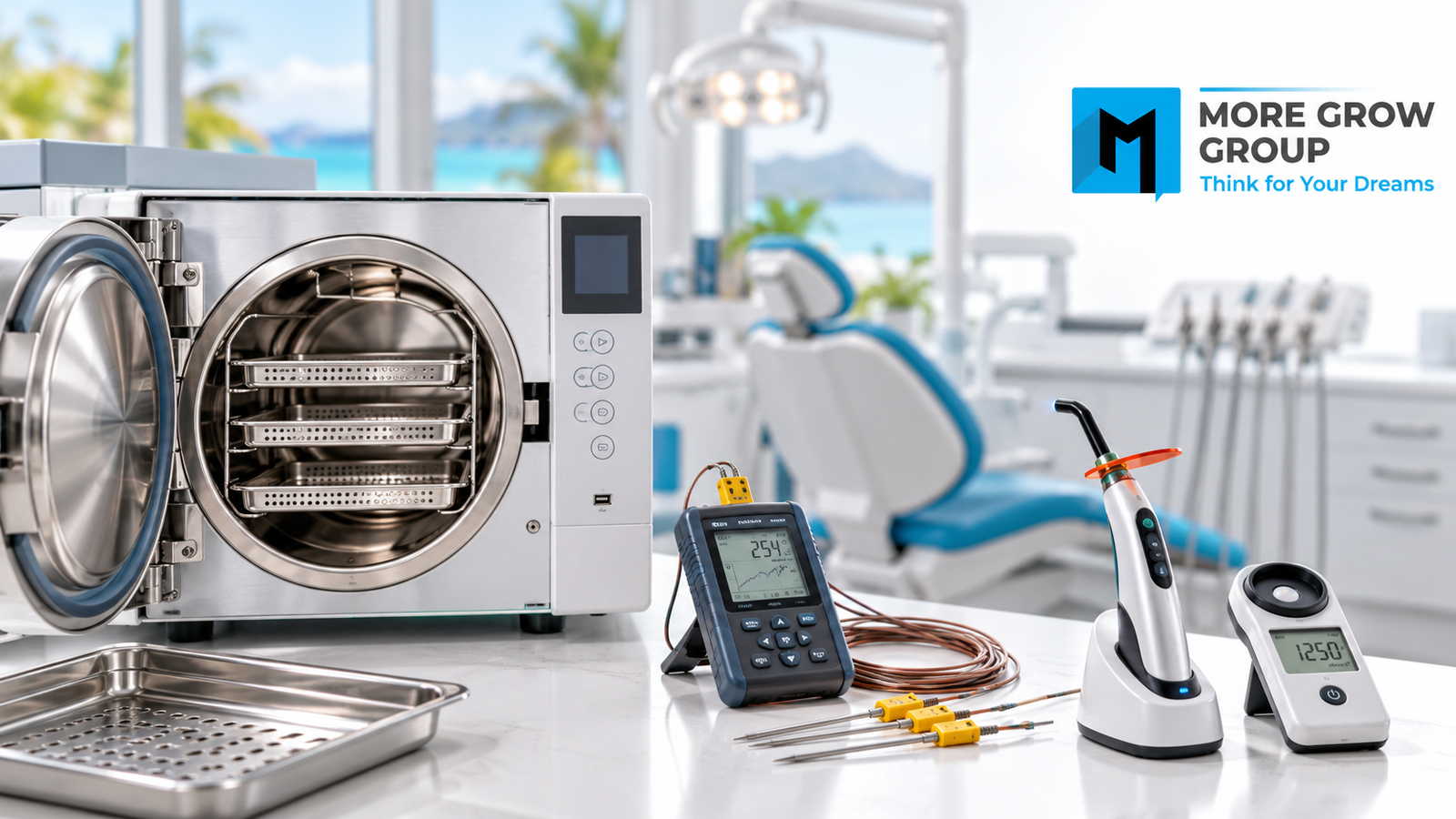
Dental equipment calibration in Fiji helps clinics assess the accuracy of measurements used in equipment operation, monitoring and quality control.
However, calibration is only one part of equipment management. Dental chairs, sterilizers, curing lights, imaging systems and other devices have different inspection, testing and maintenance requirements.
A structured programme identifies which measurements require calibration, which functions need performance checks and what documentation supports continued use.
For clinics approaching More Grow Group Fiji, a clear equipment inventory and service brief provide a practical starting point.
1. Understand What Calibration Does
Calibration establishes the relationship between an instrument’s readings and reference values under specified conditions, with associated measurement uncertainty.
It can help determine whether a temperature display, pressure indication or other measurement function provides suitable results for its intended use.
Calibration does not automatically include adjustment, repair or a declaration that the complete device is safe.
Activities to Distinguish
- Calibration: Comparing measurement indications with suitable references.
• Adjustment: Changing an instrument to improve its indications.
• Performance verification: Checking operation against defined requirements.
• Preventive maintenance: Completing planned servicing activities.
• Electrical safety testing: Assessing relevant electrical safety characteristics.
• Process validation: Establishing evidence that a defined process achieves its intended outcome.
A proposal should state which activities are included for each device.
2. Build an Accurate Dental Equipment Inventory
Start with a register of the equipment used throughout the clinic.
Include treatment rooms, instrument processing areas and supporting equipment where relevant.
Useful Information to Record
- Equipment description.
• Manufacturer and model.
• Serial number.
• Internal asset number.
• Location.
• Intended use.
• Responsible staff member.
• Manufacturer instructions.
• Previous service and test records.
• Known faults.
• Current service status.
An inventory helps distinguish similar devices and prevents reports from being assigned to the wrong asset.
3. Identify Which Equipment Needs Which Service
Avoid applying a general “calibration” label to every item.
The appropriate work depends on the device, its measurement functions and the manufacturer’s instructions.
| Equipment or function | Assessment to discuss |
| Sterilizer temperature, pressure and timing indications | Calibration or verification of relevant measurement functions |
| Complete sterilizer process | Appropriate validation, monitoring and maintenance |
| Curing light | Output assessment using a suitable method |
| Dental chair and delivery unit | Mechanical, functional and relevant electrical checks |
| Compressor and suction equipment | Performance, protective controls and maintenance |
| Clinical measuring instruments | Calibration or verification where applicable |
| Dental imaging equipment | Specialist performance and radiation-safety assessment |
This table is a planning guide. Qualified personnel should confirm the actual scope for each model.
4. Prioritise Sterilizer Measurement Performance
Dental sterilizers rely on controlled process conditions. Their displays and records must be assessed within the manufacturer’s operating requirements and the clinic’s reprocessing programme.
Relevant measurement functions may include temperature, pressure and exposure time.
Questions to Clarify
- Which sensors and displays will be assessed?
• Which cycles are included?
• What reference equipment will be used?
• What acceptance criteria apply?
• Will testing assess the complete cycle or selected indications?
• Is separate process validation required?
• What checks are needed after servicing?
A calibrated temperature display does not, by itself, establish that every instrument load has been sterilized successfully.
5. Keep Routine Sterilization Monitoring Separate
Periodic technical work does not replace routine monitoring of instrument processing.
CDC guidance describes mechanical monitoring as checking and recording sterilizer indications such as pressure, temperature and exposure time. It also recommends mechanical, chemical and biological monitoring as complementary measures. CDC
<h3>Clinic Procedures Should Address</h3>
- Manufacturer instructions for the selected cycle.
• Cleaning and preparation of instruments.
• Packaging and loading arrangements.
• Required monitoring methods.
• Recording and reviewing results.
• Responses to failed indicators or abnormal cycles.
• Responsibilities for releasing processed instruments.
CDC guidance is an international reference, not a statement of Fiji’s legal requirements. Confirm the applicable local requirements and facility procedures separately.
6. Assess Curing Lights With a Suitable Method
A curing light may illuminate normally while its output or condition requires attention.
Assessment should consider the device, operating mode and manufacturer specifications.
Review Points Include
- Light guide condition and cleanliness.
• Damage or contamination affecting output.
• Battery and charging condition.
• Selected operating mode.
• Timing functions.
• Suitability of the measuring instrument.
• Consistency of the measurement arrangement.
Not every light meter is suitable for every curing light. The method must account for relevant characteristics, including spectral compatibility and measurement geometry.
An output reading alone does not establish adequate curing of every dental material in every clinical situation.
7. Include Functional and Safety Checks
Some equipment concerns involve movement, connections, protective controls or electrical condition rather than measurement accuracy.
Dental chair operation, suction performance and delivery systems therefore need an appropriate service scope.
Checks to Discuss May Include
- Visible damage.
• Hoses and connections.
• Controls and foot switches.
• Chair movement and protective functions.
• Leaks or unusual noise.
• Suction and compressed-air performance.
• Relevant electrical safety tests.
• Manufacturer-specified servicing.
Water quality and infection-control arrangements also require their own procedures. They are not established by a general calibration certificate.
8. Use Specialist Assessment for Imaging Equipment
Dental X-ray equipment requires a different assessment from ordinary clinic instruments.
Its operation involves imaging performance and radiation protection, alongside relevant electrical and mechanical considerations.
Information to Provide
- Equipment type and model.
• Installation location.
• Existing authorisation and inspection records.
• Previous quality assurance reports.
• Reported image-quality problems.
• Repairs or changes since the last assessment.
Confirm the applicable Fiji requirements with the responsible authority and suitably qualified specialists.
Do not assume that a general biomedical service booking includes radiation surveys, imaging quality assurance or regulatory approval.
9. Set Service Intervals Using Evidence
There is no single calibration interval suitable for all dental equipment.
Use manufacturer instructions, applicable requirements, clinical risk and equipment history to establish the schedule.
WHO’s medical equipment maintenance guidance considers manufacturer recommendations and equipment history when planning maintenance. iris.who.int
Factors to Review
- Frequency and intensity of use.
• Consequences of inaccurate performance.
• Previous results and drift.
• Operating environment.
• Manufacturer requirements.
• Repairs or component replacement.
• Relocation or suspected damage.
• Unexpected operating behaviour.
A planned due date should not delay assessment when a fault is suspected.
10. Define Acceptance Criteria Before Testing
The service provider and clinic should understand what the results will be assessed against.
Acceptance limits may come from manufacturer specifications, an applicable procedure or other justified requirements.
Confirm in Advance
- Functions and ranges included.
• Relevant operating points.
• Test methods.
• Acceptance limits.
• Measurement uncertainty where applicable.
• Any requested pass or fail statement.
• Decision rule for that statement.
• Excluded activities.
Ask the provider to identify limitations that could affect interpretation.
A certificate should not imply complete-device approval when only one measurement function was assessed.
11. Plan Access, Decontamination and Downtime
Prepare equipment for technical work using an agreed process.
Follow manufacturer instructions and the receiving provider’s requirements for cleaning and decontamination.
Preparation Details Include
- Equipment and accessory list.
• Reported faults.
• Cleaning or decontamination status.
• Available manuals.
• Previous reports.
• Access to equipment and utilities.
• Suitable service times.
• Transport arrangements where needed.
• Management of clinical downtime.
For clinics requiring inter-island transport, confirm packaging, freight and return arrangements early.
Do not send contaminated equipment without prior agreement.
12. Review Reports Before Returning Equipment to Use
A service label is a quick status indicator. The supporting report explains what was actually done.
Documentation to Check
- Correct equipment identity.
• Date and location of work.
• Functions assessed.
• Methods and reference equipment.
• Results and relevant uncertainty.
• Acceptance criteria and conclusions.
• Repairs or adjustments.
• Results before adjustment where available.
• Limitations and outstanding actions.
• Responsible service personnel.
Record who reviewed the findings and authorised return to service.
What If Results Are Unacceptable?
Restrict the affected equipment from use as appropriate while qualified personnel assess the findings.
Consider:
- The function affected.
• Whether repair or adjustment is required.
• What further testing is needed.
• Whether earlier work may have been affected.
• What clinical or infection-control review is necessary.
Do not assume that a later satisfactory result resolves all questions about previous use.
13. Connect Equipment Records With Compliance Reviews
Calibration and maintenance records can support audits by showing how a clinic manages equipment.
They do not independently establish compliance with every clinical, infection-control, electrical or radiation-safety obligation.
Maintain Accessible Records For
- Equipment inventories.
• Manufacturer instructions.
• Maintenance schedules.
• Calibration and test reports.
• Sterilization monitoring.
• Repairs and corrective actions.
• Staff training.
• Authorised release decisions.
• Applicable inspections and approvals.
Assign responsibility for checking due dates, reviewing reports and following up unresolved findings.
A Practical Dental Equipment Management Checklist
| Review area | What to confirm |
| Inventory | Every device has a clear identity and location |
| Intended use | Relevant functions and clinical purpose are understood |
| Service scope | Calibration, verification and maintenance are distinguished |
| Sterilizers | Measurement checks and process requirements are separately defined |
| Routine monitoring | Reprocessing checks continue between service visits |
| Curing lights | Assessment method suits the device |
| Safety checks | Relevant functional and electrical assessments are included |
| Imaging | Specialist requirements are addressed |
| Intervals | Schedule reflects instructions, risk and history |
| Preparation | Access and decontamination arrangements are agreed |
| Reports | Results, limitations and actions are reviewed |
| Release | Return to service is authorised and recorded |
Common Dental Equipment Management Mistakes to Avoid
Common mistakes include:
- Calling every service activity calibration.
• Assuming a calibration certificate proves complete safety.
• Replacing routine sterilization monitoring with annual servicing.
• Applying one service interval to all devices.
• Using unsuitable instruments for output checks.
• Ignoring repeated faults between scheduled visits.
• Failing to identify detachable accessories.
• Treating international guidance as Fiji law.
• Returning equipment to use without reviewing results.
• Assuming all specialist services are included.
A clear scope and documented follow-up help avoid these misunderstandings.
Preparing an Enquiry for More Grow Group Fiji
Clinics approaching More Grow Group Fiji should provide an equipment list and describe the support required.
Ask for Confirmation of
- Equipment models that can be supported.
• Proposed calibration, testing and maintenance activities.
• Applicable methods and acceptance criteria.
• Relevant technical competence.
• On-site or laboratory arrangements.
• Specialist work requiring another provider.
• Expected downtime.
• Documentation supplied.
• Itemised costs and exclusions.
• Follow-up support.
Confirm any accreditation claims against the exact service and scope rather than assuming all work is accredited.
Building a Documented Equipment Programme
Dental equipment calibration in Fiji can support reliable measurements when it forms part of a wider equipment management programme.
Identify each device’s requirements, maintain routine checks and arrange suitable technical assessment. Review the findings before returning equipment to service and retain records of outstanding actions.
Providing this information to More Grow Group Fiji helps establish a service proposal around the clinic’s actual equipment and operational needs.





Leave A Comment