
Introduction
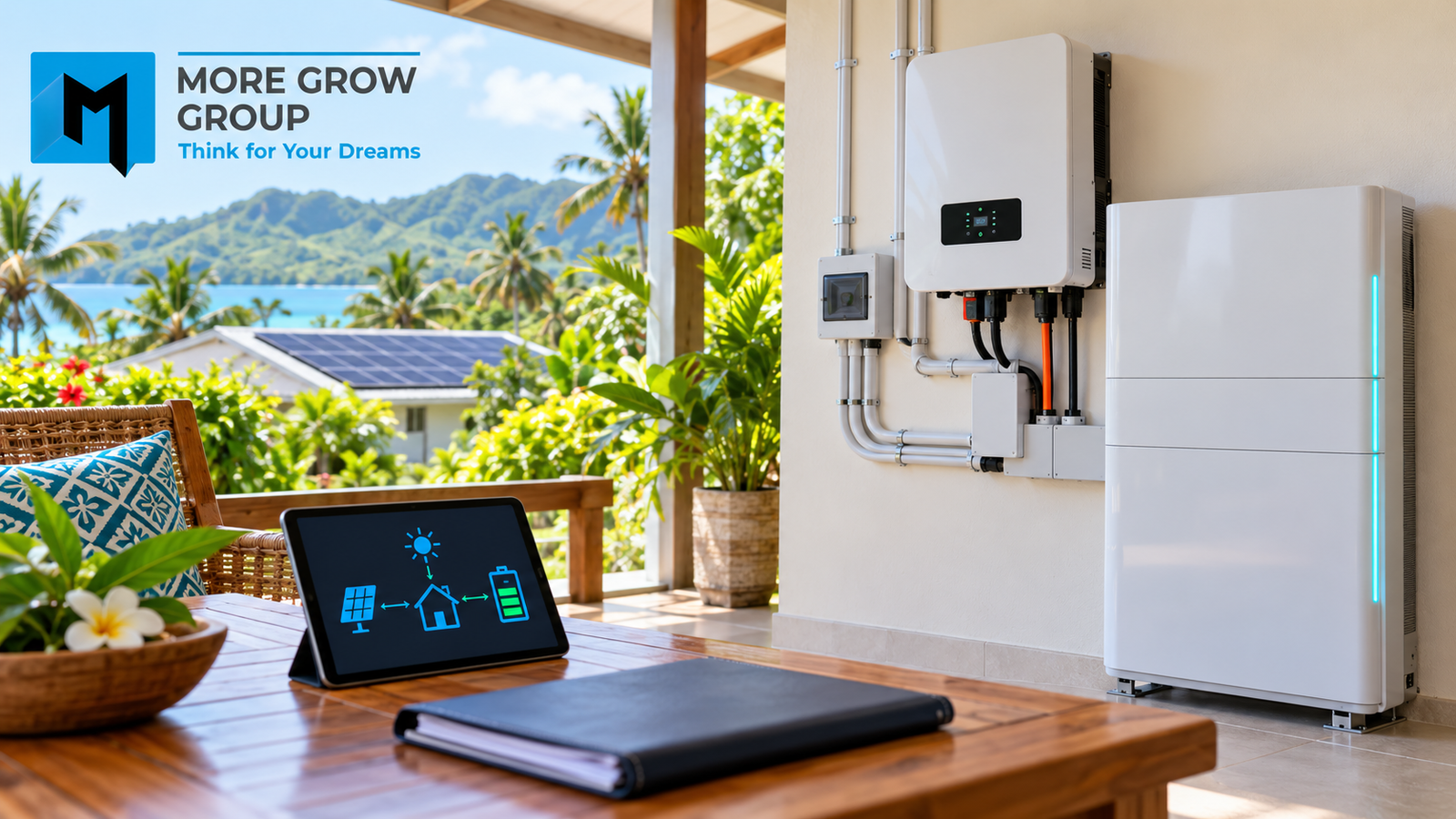
Residential solar systems in Fiji allow households to generate electricity from sunlight and use it to support their daily energy needs.
However, choosing a system involves more than selecting a set of panels. Electricity consumption, roof condition, shading, battery requirements and installation arrangements all influence whether a proposed system suits the home.
Some households want to reduce daytime electricity purchases. Others need backup for essential appliances or a dependable supply where grid access is unavailable.
For homeowners considering a solar solution with More Grow Group Fiji, understanding these differences helps create a clear project brief and compare proposals.
1. Understand How a Residential Solar System Works
Solar photovoltaic panels convert sunlight into direct-current electricity.
An inverter converts that electricity into alternating current suitable for compatible household appliances. Depending on the design, electricity may supply the home, charge a battery or flow to the grid under an authorised connection arrangement.
Main Components May Include
- Solar panels.
• Roof or ground mounting structures.
• An inverter.
• Electrical cables and connectors.
• Protective devices and isolation equipment.
• Monitoring equipment.
• Battery storage where specified.
• Battery charging controls where required.
• Metering and backup switching equipment where applicable.
Not every system includes every component in the same configuration.
Ask the installer to explain how the proposed equipment works together and what happens when sunlight or grid power is unavailable.
2. Define What You Want Solar to Achieve
Start with the household’s main objective.
A system designed to reduce daytime grid purchases may differ substantially from one intended to supply an isolated home through several cloudy days.
Common Objectives Include
- Reducing electricity purchased during daylight hours.
• Supporting evening consumption through battery storage.
• Keeping selected appliances operating during outages.
• Supplying a home without a grid connection.
• Accommodating planned appliances.
• Reducing dependence on generator operation.
Identify which objective matters most and what budget is available.
Avoid assuming that one standard package will provide bill savings, whole-home backup and extended off-grid operation equally well.
3. Learn the Difference Between System Types
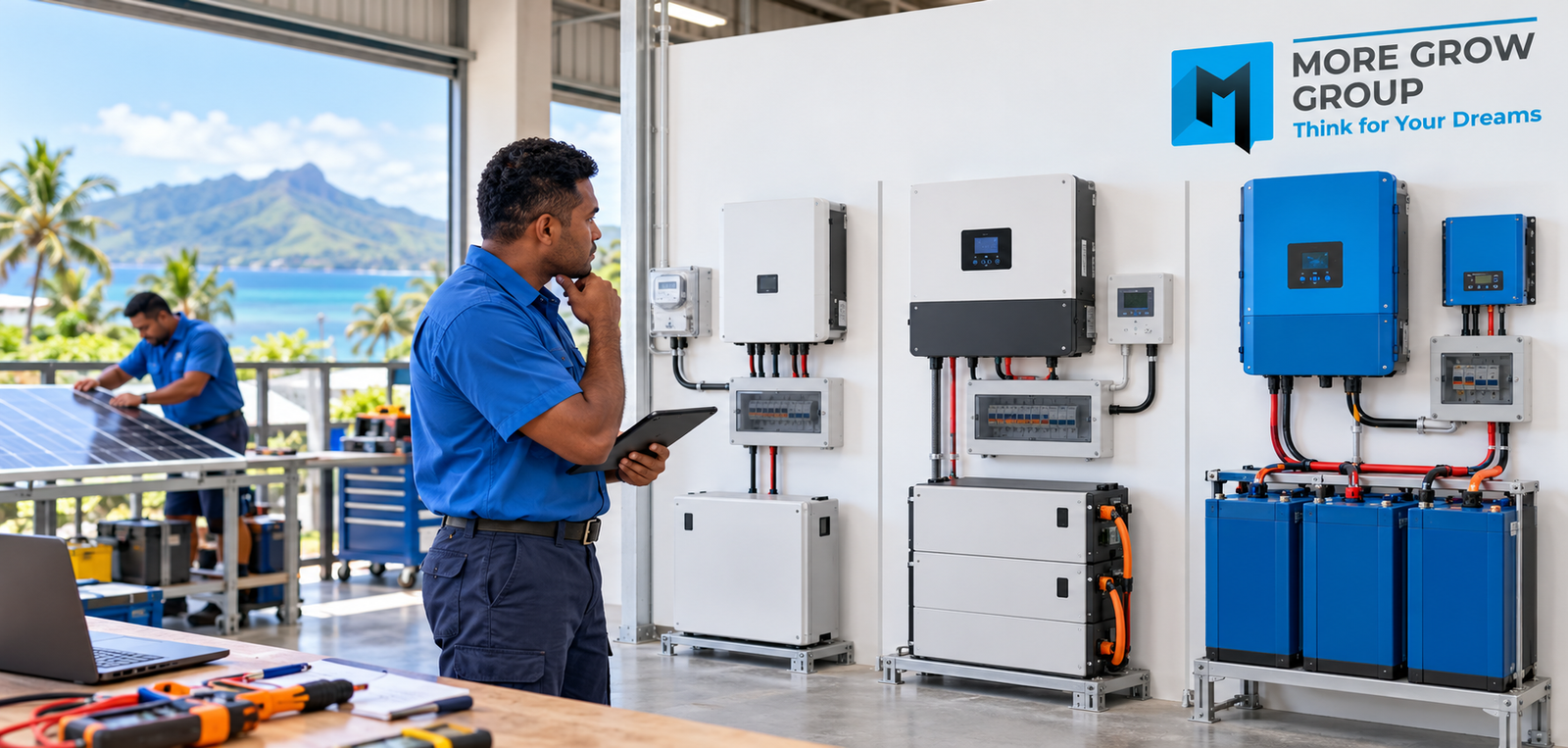
Residential solar systems are commonly described as grid-connected, hybrid or off-grid.
These terms describe different arrangements, but the exact capabilities depend on the equipment and installation.
Grid-Connected Solar
A grid-connected system operates alongside the electricity network.
Solar generation can supply household demand during suitable conditions. The home draws electricity from the grid when solar output is insufficient.
A conventional grid-connected system generally stops supplying the home during an outage unless it has specifically designed backup capability.
Hybrid Solar
A hybrid arrangement combines solar generation with battery storage and, commonly, a grid connection.
However, a battery or a product labelled “hybrid” does not automatically provide backup to every circuit.
Confirm the inverter’s capabilities, switching arrangements and circuits included.
Off-Grid Solar
An off-grid system supplies a property independently of the electricity network.
It needs careful assessment of daily consumption, peak demand, battery storage and periods of poor solar generation. A generator may form part of the design.
A Simple System Comparison
| System type | Main arrangement | Important question |
| Grid-connected | Solar operates alongside the grid | What happens during a grid outage? |
| Hybrid | Solar and batteries operate within a coordinated system | Which circuits receive backup, and for how long? |
| Off-grid | The home operates independently of the grid | How will demand be supplied during prolonged low generation? |
The US Department of Energy explains that conventional grid-dependent solar can lose supply during outages, while appropriately configured storage can support resilience.
4. Review Your Household Electricity Use
Collect electricity bills and prepare an appliance list before requesting a design.
Monthly consumption helps establish overall demand, while appliance operating times explain when electricity is needed.
Information to Collect
- Available electricity bills covering different seasons.
• Monthly electricity consumption in kilowatt-hours.
• Appliances used during daylight hours.
• Evening and overnight consumption.
• Air-conditioning operating patterns.
• Water heating arrangements.
• Pump and refrigeration requirements.
• Planned appliances or household changes.
• Existing generator use where relevant.
A household that uses most electricity after sunset may have different requirements from one occupied throughout the day.
Measured consumption is preferable to assumptions based only on the number of bedrooms.
5. Understand Kilowatts and Kilowatt-Hours
Kilowatts and kilowatt-hours describe different things.
A kilowatt, written as kW, measures power. A kilowatt-hour, written as kWh, measures energy used or generated over time.
<h3>Hypothetical Example</h3>
- Appliance power: 100 watts, equivalent to 0.1 kW.
• Operating time: Five hours.
• Energy used: 0.1 kW × 5 hours = 0.5 kWh.
This calculation assumes the appliance draws a constant 100 watts throughout that period.
Refrigerators, air conditioners and other cycling appliances need a more suitable estimate or measurement.
A 5 kW solar array does not generate 5 kW continuously or guarantee a fixed daily energy output.
6. Arrange a Roof and Site Assessment
The site affects how much electricity the system can generate and how it should be installed.
A roof needs to support the proposed mounting arrangement and remain suitable for the installation’s expected service life.
Assessment Points Include
- Roof condition and remaining useful life.
• Structural suitability.
• Available installation area.
• Roof orientation and slope.
• Shade from trees and nearby buildings.
• Access for installation and maintenance.
• Cable routes.
• Inverter and battery locations.
• Coastal exposure.
• Wind exposure and drainage.
For homes in Fiji, ask how the design addresses local wind conditions, heavy rain, corrosion and the specific building structure.
Do not accept a generic mounting claim as proof that the installation suits the property.
7. Size the System Around Demand and Site Conditions
System sizing should connect household consumption with expected generation.
Panel capacity alone does not establish how much useful electricity the household will receive.
A Design Should Consider
- Daily and seasonal energy use.
• Timing of household demand.
• Local solar resource.
• Shading.
• Roof orientation and tilt.
• Temperature effects.
• Inverter and electrical losses.
• Battery charging requirements.
• Applicable connection constraints.
• Future demand supported by a realistic plan.
Ask for an estimated generation range and the assumptions behind it.
Avoid treating a simple panel-capacity calculation as a guaranteed production forecast.
8. Decide Whether You Need Battery Storage
A battery stores energy for later use.
It may help supply evening demand or provide backup when the system is designed for that purpose. However, storage adds cost and has operating limits.
Battery Details to Review
- Nominal capacity.
• Usable energy capacity.
• Continuous output power.
• Short-duration surge capability.
• Charging limits.
• Backup reserve settings.
• Installation conditions.
• Compatibility with the inverter.
• Warranty terms.
• Expected capacity reduction over time.
Battery capacity in kWh and output power in kW are separate specifications.
A battery may store enough energy for several hours of modest demand while being unable to start a large pump.
Hypothetical Runtime Example
If 4 kWh is available to supply appliances and their combined constant demand is 0.5 kW:
Estimated runtime = 4 kWh ÷ 0.5 kW = 8 hours.
This simplified calculation excludes further losses, changing loads and operating restrictions. It is not a guaranteed backup duration.
9. Identify Essential Backup Loads
Choose which appliances need to operate during an outage.
Backing up selected circuits can create a different design requirement from supplying the entire house.
Possible Essential Loads Include
- Selected lights.
• Refrigerator or freezer.
• Phone charging.
• Internet equipment.
• Selected fans.
• A suitable water pump where included in the design.
Discuss high-demand appliances separately.
Electric cooking, water heating and air conditioning can consume stored energy quickly. Motors may also require additional starting power.
Ask the installer to document the backup circuits, operating limits and expected behaviour when the battery reaches its reserve level.
10. Confirm Connection and Approval Requirements
Before purchasing a grid-interactive system, confirm the current requirements for the property and proposed equipment with Energy Fiji Limited and the relevant authorities.
Do not assume that permission to connect household electricity also authorises solar export.
Questions to Resolve
- What applications and approvals apply?
• Is the proposed system acceptable for this connection?
• Is electricity export permitted?
• Are export limits or control settings required?
• What metering arrangements apply?
• Are inspections required?
• Who prepares and submits the documents?
• When may the system be commissioned and operated?
EFL’s residential connection guidance directs customers to use an EFL-licensed electrical contractor and describes inspection of wiring and installations. Confirm the additional requirements applicable to the proposed solar project directly. Energy Fiji Limited
Obtain written confirmation of any export payment arrangement before including it in a financial estimate.
11. Compare Quotations Beyond Panel Quantity
A useful quotation explains the complete proposed installation.
Two systems with the same advertised panel capacity can differ in equipment, mounting, backup capability and service support.
Quotation Details to Request
- Panel manufacturer, model and total capacity.
• Inverter manufacturer, model and rating.
• Battery model and usable capacity where included.
• Mounting design and roof-work scope.
• Electrical protection and switchboard work.
• Monitoring arrangements.
• Backup circuits where applicable.
• Approval and inspection responsibilities.
• Installation and commissioning charges.
• Transport and inter-island costs where relevant.
• Taxes, exclusions and payment stages.
• Warranty and after-sales support.
Ask whether roof repairs, access equipment or switchboard upgrades are excluded.
Compare equivalent scopes before deciding which quotation offers suitable value.
How Much Can a Residential Solar System Save?
Savings depend on how much generated electricity the household uses, the electricity charges avoided and the system’s total ownership costs.
Generation alone does not determine bill reduction.
Factors Affecting Savings Include
- Installed cost.
• Daytime self-consumption.
• Seasonal generation.
• Current electricity tariff structure.
• Any authorised export arrangement.
• Battery losses and operating settings.
• Maintenance and replacement costs.
• Finance charges where applicable.
• Changes in household consumption.
Hypothetical Savings Calculation
Assume a home uses 200 kWh of solar electricity in a month that would otherwise have been purchased at an assumed marginal rate of FJ$0.40 per kWh.
Illustrative avoided energy charge:
200 kWh × FJ$0.40 = FJ$80.
This example does not state EFL’s current tariff. It excludes fixed charges, export credits, finance costs and other ownership expenses.
Request a calculation based on your actual bills and clearly stated assumptions.
Prepare for Installation and Handover
Agree on the installation scope, access arrangements and expected electricity interruptions before work begins.
Use appropriately qualified personnel for electrical and structural work.
Handover Information Should Include
- Equipment model and serial numbers.
• System layout and relevant electrical diagrams.
• Commissioning and test records.
• Applicable approval documents.
• Operating instructions.
• Monitoring access.
• Backup limitations.
• Manufacturer shutdown instructions.
• Warranty documents.
• Maintenance schedule and service contacts.
Ask for a demonstration of normal operation and any backup function included in the installation.
Keep the documents somewhere accessible to the household and future service personnel.
A Practical Residential Solar Planning Checklist
| Review area | What to confirm |
| Objective | Savings, backup or off-grid supply priorities |
| Consumption | Daily energy use and timing of demand |
| Essential loads | Appliances and circuits requiring backup |
| Roof condition | Structural suitability and remaining useful life |
| Site conditions | Shade, wind, rain and coastal exposure |
| System type | Grid-connected, hybrid or off-grid arrangement |
| Panel capacity | Design matches demand and available space |
| Inverter | Suitable power rating and operating capabilities |
| Battery | Usable capacity, output and installation conditions |
| Connection | Applicable permissions, metering and export arrangements |
| Quotation | Equipment, installation, exclusions and total price |
| Savings | Documented assumptions using current household information |
| Handover | Testing, operating instructions and warranty records |
| Support | Maintenance responsibilities and service availability |
Maintain the System and Monitor Performance
Solar equipment needs periodic attention.
Monitoring can help identify changes, but a low-output day does not necessarily indicate a fault.
Routine Review Areas Include
- Generation trends over comparable periods.
• Inverter warnings.
• Monitoring connectivity.
• New shading.
• Visible damage observed safely from ground level.
• Battery alerts where applicable.
• Inspection and maintenance dates.
• Unexplained changes in electricity purchases.
Follow the installer’s and manufacturers’ maintenance instructions.
Do not climb onto the roof, open electrical equipment or disconnect solar connectors to investigate a problem yourself.
After severe weather or suspected damage, arrange qualified assessment before assuming normal operation remains safe.
Common Mistakes to Avoid
Common mistakes include:
- Choosing a package without reviewing household consumption.
• Confusing kW with kWh.
• Assuming panels provide electricity throughout the night.
• Expecting every grid-connected system to work during outages.
• Selecting a battery by capacity alone.
• Ignoring roof condition and shading.
• Assuming all generated electricity earns a payment.
• Accepting savings estimates without their assumptions.
• Overlooking transport and servicing costs.
• Treating panel warranties as a complete system warranty.
A clear design and documented scope make these differences easier to assess before committing to the installation.
Discussing Residential Solar With More Grow Group Fiji
When approaching More Grow Group Fiji, provide the property location, available electricity bills and your main energy objectives.
Explain whether the home has a grid connection, an existing generator or particular backup requirements.
Ask for Confirmation of
- Site assessment arrangements.
• Proposed system type.
• Equipment specifications.
• Expected generation and its assumptions.
• Battery and backup options.
• Roof and mounting assessment.
• Connection and approval responsibilities.
• Installation costs and exclusions.
• Commissioning documentation.
• Warranty and service support.
For outer-island properties, discuss transport, site access and future maintenance arrangements at the enquiry stage.
Confirm the services available for the specific property and project.
Planning a Solar System That Fits Your Home
Residential solar systems in Fiji should be planned around the household’s electricity use, site conditions and supply requirements.
Start with consumption records and a clear objective. Compare system types, assess the roof and confirm battery, connection and support arrangements before approving a proposal.
A detailed project brief helps homeowners discuss a suitable solar solution with More Grow Group Fiji and understand what the proposed installation can deliver.




Leave A Comment