
Introduction
Temperature and humidity measurements help businesses make decisions about storage, processing, product quality, and indoor conditions. When instruments provide incorrect readings, staff may believe conditions are acceptable even when they require attention.
For Fiji businesses managing cold rooms, warehouses, laboratories, hotels, or production facilities, reliable monitoring starts with suitable instruments and an organised calibration programme.
Calibration helps establish how an instrument’s readings compare with recognised references. Its value depends on selecting relevant measurement points, reviewing the results, and taking appropriate action when equipment does not meet the requirements of its intended use.
1. What Is Temperature Calibration?
Temperature calibration establishes the relationship between an instrument’s temperature readings and reference values under specified conditions.
Equipment may include:
- Digital thermometers.
- Temperature probes.
- Thermocouples.
- Resistance temperature detectors.
- Temperature data loggers.
- Monitoring systems.
- Infrared thermometers, using an appropriate method.
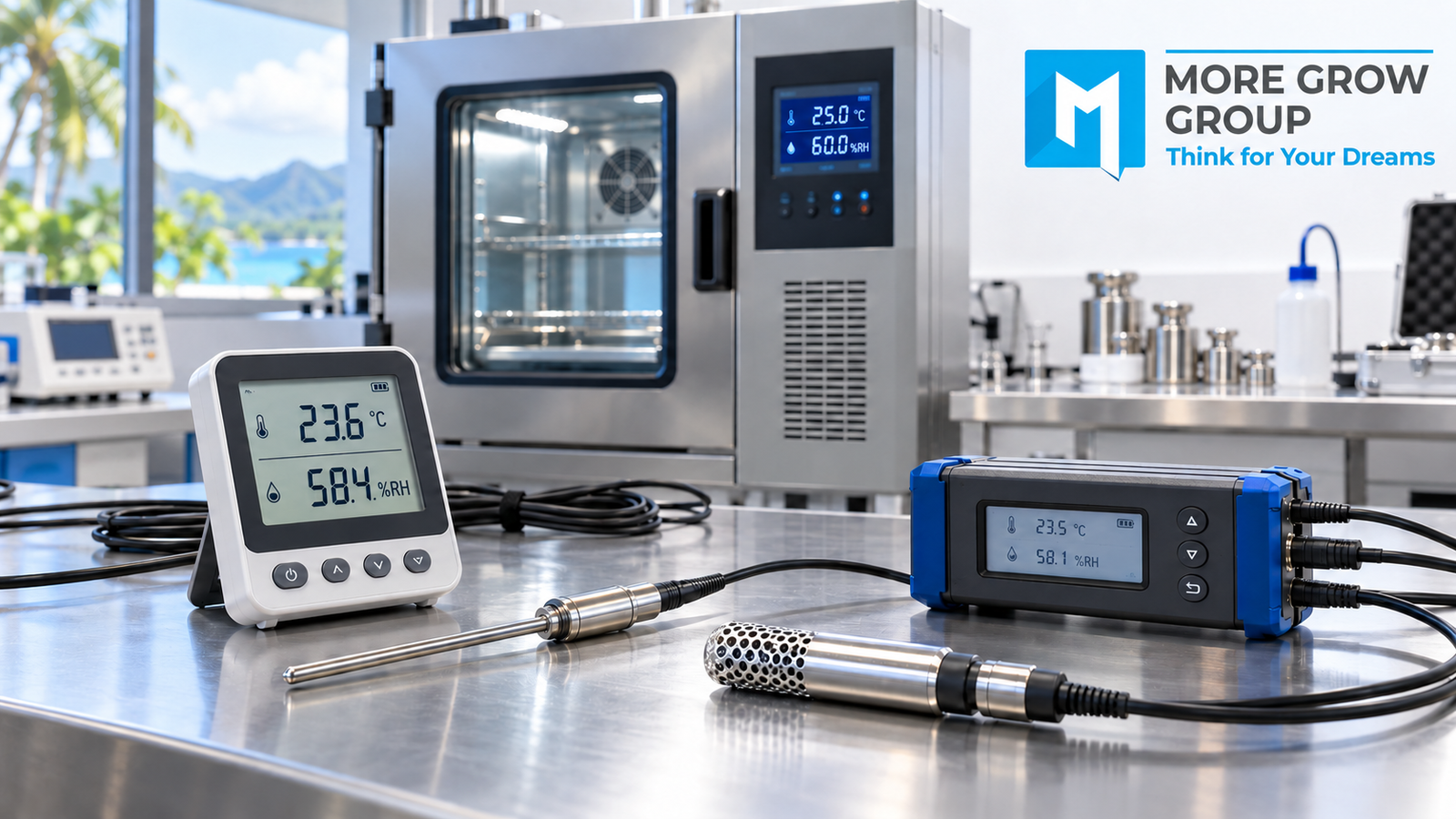
Depending on the instrument, calibration may use a controlled bath, dry-block calibrator, environmental chamber, or other suitable source and reference.
The selected calibration points should reflect how the instrument is used. A thermometer used in refrigerated storage needs different test points from a probe used in a heated production process.
2. What Is Humidity Calibration?
Humidity calibration evaluates an instrument’s readings against suitable humidity reference values under controlled conditions.
Common instruments include:
- Digital hygrometers.
- Thermohygrometers.
- Humidity data loggers.
- Environmental monitoring sensors.
- Humidity transmitters.
Many instruments report relative humidity, expressed as a percentage. Relative humidity depends on temperature, so temperature control and adequate stabilisation are important during calibration.
The National Physical Laboratory’s humidity guidance covers measurement methods, instrument performance, calibration, and the effects of temperature on humidity measurements.
Businesses should specify both the humidity range and the temperature conditions relevant to their application.
3. Why Does Calibration Matter for Fiji Businesses?
Businesses need dependable measurements to determine whether their operating conditions meet defined requirements.
For example, a warehouse may use humidity readings to assess storage conditions for moisture-sensitive goods. A food business may use temperature readings when checking refrigerated stock or a production process.
If the instrument has an unacceptable error, staff may make decisions using misleading information.
Calibration can help businesses:
- Identify measurement errors.
- Assess whether instruments are suitable for use.
- Review changes in performance over time.
- Support quality investigations.
- Maintain documented equipment controls.
- Make informed adjustment or replacement decisions.
Calibration does not control the environment itself. Refrigeration, ventilation, maintenance, and operating procedures must also work effectively.
4. Which Fiji Businesses May Need These Services?
Temperature and humidity calibration can be relevant across several industries.
Examples include:
- Food processing and hospitality: Checking instruments used for storage, preparation, and processing.
- Warehousing and distribution: Monitoring conditions for sensitive stock.
- Healthcare and pharmaceutical storage: Assessing instruments used to monitor specified storage conditions.
- Laboratories: Supporting environmental monitoring and temperature-dependent testing.
- Manufacturing: Checking sensors used in production and quality control.
- Agriculture and agricultural processing: Monitoring drying, storage, or controlled environments.
- Building services: Assessing instruments used to investigate indoor environmental conditions.
Not every business needs the same accuracy or calibration scope. Requirements should reflect the products, processes, and decisions involved.
5. How Should Businesses Choose Calibration Points?
Calibration should cover the conditions that matter to the instrument’s actual use.
Before requesting a service, identify:
- The normal operating range.
- Critical decision points.
- Required measurement accuracy.
- Permitted measurement error.
- Whether both temperature and humidity channels need calibration.
- Whether the sensor, display, and recording system need assessment together.
For example, an instrument used to monitor a narrow controlled range may need calibration points near that range’s limits. Equipment used across a wider range may need additional points.
A calibration at one point does not establish performance across every temperature or humidity condition.
6. What Are Measurement Traceability and Uncertainty?
Measurement traceability connects a result to a reference through a documented, unbroken chain of calibrations, with each calibration contributing to uncertainty.
The international vocabulary of metrology identifies this documented chain as central to metrological traceability.
Measurement uncertainty describes the dispersion of values that can reasonably be associated with the measured quantity. It helps explain the limits of confidence in a reported result.
For businesses, the practical question is whether the calibration results and uncertainty are suitable for the intended decision.
A certificate stating that an instrument was calibrated does not automatically mean that it meets the business’s acceptance limits.
7. How Often Should Instruments Be Calibrated?
There is no single calibration interval suitable for every temperature or humidity instrument.
Consider:
- Manufacturer recommendations.
- Frequency of use.
- Required accuracy.
- Previous calibration results.
- Exposure to contamination or condensation.
- Handling, transport, and physical damage.
- The consequences of an incorrect reading.
- Applicable customer, quality-system, or regulatory requirements.
An instrument used frequently in demanding conditions may need closer monitoring than one used occasionally in a stable environment.
Review the interval using performance history. Additional checks or calibration may be needed after damage, repair, adjustment, or an unexplained change in readings.
8. Is Calibration the Same as Adjustment or Environmental Mapping?
These activities address different questions.
Calibration establishes how an instrument’s readings relate to reference values. Adjustment changes the instrument’s response to improve its performance.
Where adjustment is performed, results before and after the work can help establish the instrument’s earlier condition and its suitability following the change.
Environmental mapping examines how temperature or humidity varies across a space over time. It can help identify suitable monitoring locations and areas with different conditions.
Calibrating a data logger does not demonstrate that an entire cold room or warehouse maintains uniform conditions. Similarly, a successful mapping exercise does not replace calibration of the instruments used.
9. What Should a Calibration Certificate Include?
Depending on the service, useful certificate information may include:
- Instrument description, model, and serial number.
- Business asset number.
- Calibration date.
- Method or procedure.
- Measurement points.
- Reference values and instrument readings.
- Reported errors or corrections.
- Measurement uncertainty.
- Relevant environmental conditions.
- Traceability information.
- As-found and as-left results, where applicable.
- A statement of conformity, where agreed and applicable.
- Authorised approval.
Staff should review the certificate rather than simply file it.
Check that the instrument identity is correct, the points match its intended use, and the results support the decision to keep it in service.
10. How Can Businesses Prepare Equipment for Calibration?
Preparation helps the provider perform the correct work and reduces avoidable delays.
Useful steps include:
- Identify each instrument with a unique asset number.
- Explain its application and operating range.
- Specify required calibration points and acceptance limits.
- Supply the probes, displays, cables, or accessories needed.
- Check batteries and basic operation.
- Clean equipment according to manufacturer instructions.
- Report known damage or unusual readings.
- Request as-found results before adjustment where needed.
- Arrange replacement monitoring equipment during downtime.
- Agree on documentation and service arrangements.
For data loggers, download important records before servicing. Confirm whether settings, stored data, or alarm configurations could be affected.
11. What Should Businesses Do When Results Are Out of Tolerance?
An unacceptable result requires an assessment of both the instrument and the work that depended on it.
A practical response includes:
- Identifying and controlling the affected instrument.
- Reviewing the size and direction of the error.
- Assessing potentially affected monitoring records or decisions.
- Arranging adjustment, repair, or replacement.
- Obtaining appropriate results after corrective work.
- Recording the investigation and actions taken.
- Authorising the instrument before returning it to use.
A failed calibration does not automatically prove that all stored products were affected. Equally, it should not be ignored because the equipment appeared to operate normally.
The assessment should consider the error, its likely duration, recorded conditions, and the requirements of the affected products or processes.
12. How Can Businesses Maintain Reliable Monitoring Between Calibrations?
Calibration provides information about performance at the time and conditions of the service. Routine controls help businesses identify problems between scheduled calibrations.
Useful measures include:
- Inspecting probes and cables for damage.
- Checking batteries and communication failures.
- Reviewing unexpected changes in recorded values.
- Comparing instruments with a suitable reference under controlled conditions.
- Checking alarm operation.
- Following appropriate sensor-placement procedures.
- Recording faults and corrective actions.
Two instruments showing similar readings does not prove that both are accurate. Comparison checks need a suitable reference and a procedure appropriate to the required accuracy.
How Can MoreGrow Group Support a Calibration Enquiry?
When discussing temperature and humidity calibration with MoreGrow Group, provide the instrument make, model, quantity, operating range, and application.
Also explain the required accuracy, preferred service location, documentation needs, and whether downtime will affect monitoring.
These details help establish the appropriate scope of work. Confirm the available methods, measurement ranges, uncertainty, and any accreditation requirements before booking.
Where accredited calibration is required, check that the provider’s scope covers the relevant service rather than relying on a general accreditation claim.
Conclusion
Temperature and humidity calibration helps Fiji businesses assess the instruments behind their storage, processing, and environmental-monitoring decisions.
An effective programme combines suitable calibration points, certificate review, routine checks, clear records, and action when results are unacceptable.
Reliable monitoring also depends on correct sensor placement, functioning equipment, and appropriate operating procedures. Managing these elements together supports more dependable measurements and better-informed business decisions.






Leave A Comment